The drill chuck is the business end of every power drill, the critical component that holds the bit and puts the power to work. Yet for many new and even experienced DIYers, the markings, types, and features of a chuck can be a source of confusion. What does the size mean? Why do some need a key? What are those numbers on the collar for?
This expert guide will demystify the drill chuck completely. We’ll explain its fundamental purpose, break down the different types, clarify what all the numbers and specifications mean, and even touch on more advanced concepts. By the end, you’ll understand this essential tool component, enabling you to work more safely and effectively, and choose your next drill with confidence.
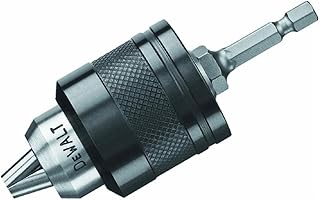
DEWALT Drill Chuck for Impact Driver, Quick Connect (DW0521)
Check PriceWhat is a Drill Chuck and What is its Purpose?
At its core, a drill chuck is a specialized, self-centering three-jaw clamp located at the end of a drill’s spindle. Its one and only purpose is to securely grip the shank (the smooth end) of a drill bit or other rotating accessory. It acts as the crucial link that transfers the rotational power from the drill’s motor to the tool bit, allowing you to drill holes or drive screws. Think of it as the drill’s hand; it needs to have a firm, precise, and reliable grip to do its job properly.
5 Best Drill Chucks
1- DEWALT DW0521 Quick Connect Impact Driver Chuck Review
DEWALT Drill Chuck for Impact Driver, Quick Connect (DW0521)
Check PriceThe DEWALT DW0521 is a highly practical accessory designed to quickly convert your 1/4-inch hex shank impact driver into a versatile driver drill. Built with a keyless mechanism, it allows fast, tool-free bit changes so you can swap from driving screws to drilling holes in seconds without changing power tools.
Featuring a durable 3/8-inch capacity chuck, it securely grips standard round-shank drill bits for light-to-medium wood and metal drilling tasks. While it doesn’t replace a heavy-duty dedicated drill press or high-torque rotary hammer, its compact design and seamless quick-connect system make it an essential time-saver for any jobsite or DIY toolkit.
- Key Advantage: Instant conversion from impact driver to drill via standard 1/4″ hex shank.
- Convenience: Hand-tightened keyless chuck for fast bit adjustments on the fly.
- Best Used For: Light wood, plastic, and thin metal drilling tasks.
2- NEIKO 20753A Keyless Drill Chuck Review
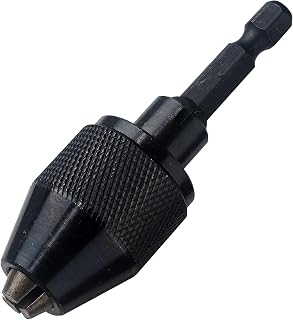
NEIKO 20753A Keyless Drill Chuck for Impact Driver, Chuck Conversion Adapter
Check PriceThe NEIKO 20753A is a compact and budget-friendly adapter engineered to turn any standard 1/4-inch hex-shank impact driver into a functional drill. Featuring a keyless, three-jaw design, it easily accommodates small round-shank drill bits ranging from 1/16-inch up to 3/8-inch, enabling quick tool-free bit changes directly on the jobsite.
Constructed with an all-metal housing, this conversion chuck is built to withstand light to medium-duty drilling applications in wood, drywall, and plastic. While it is not designed for heavy masonry or high-torque industrial operations, its lightweight profile and universal hex shank make it an excellent addition to any homeowner or DIYer’s tool bag.
- Universal Fit: Standard 1/4-inch quick-change hex shank connects instantly to most impact drivers.
- Keyless Design: 3-jaw mechanism tightens by hand for fast and effortless bit swaps.
- Best Used For: Light-duty drilling, pilot holes, and quick driving tasks.
3- Aiyun Mini Keyless Drill Chuck Adapter Review
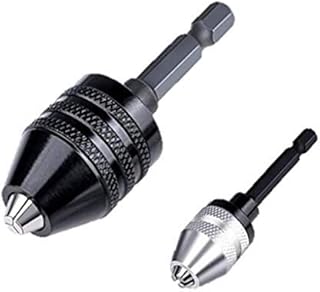
aiyun Mini Drill Chuck Adapter Impact Driver Keyless (0.6-8mm)
Check PriceThe aiyun Mini Keyless Drill Chuck Adapter is an ultra-compact conversion tool designed for precision tasks and small-diameter drilling. Supporting bit shank sizes from 0.6mm up to 8mm, it allows you to use micro-drill bits with your standard 1/4-inch hex-shank impact driver or cordless screwdriver.
Featuring a keyless 3-jaw mechanism, it enables rapid, tool-free bit changes by hand. Its lightweight and slim profile makes it ideal for detailed woodworking, circuit board work, model making, and drilling delicate pilot holes where a bulky standard chuck would be impractical.
- Micro-Bit Capacity: Grips extra-small drill bit shanks ranging from 0.6mm to 8mm.
- Quick-Connect Shank: Standard 1/4″ hex shank fits effortlessly into impact drivers and power screwdrivers.
- Best Used For: Precision craft work, fine woodworking, circuit boards, and small pilot holes.
4- 3/8-Inch Keyless Impact Driver Drill Chuck Review
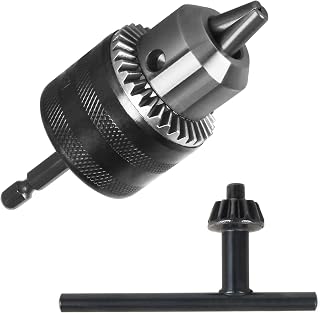
Drill Chuck 3/8 inch for Impact Driver, 1/4″ Hex Shank Quick Connect Keyless
Check PriceThe 3/8-Inch Keyless Impact Driver Drill Chuck is a heavy-duty conversion adapter built to expand the capability of standard 1/4-inch hex shank impact drivers. Featuring a robust 3/8-inch capacity, it accommodates standard round-shank twist drill bits and accessories securely without slipping.
Designed with a knurled, hand-tightened keyless sleeve, it allows for fast, tool-free bit changes directly on the job. Its durable construction ensures reliable performance for everyday drilling tasks in wood, metal, and plastic, making it a reliable addition to any tool collection.
- Standard Capacity: 3/8-inch jaw capacity handles a wide variety of standard drill bits and accessories.
- Quick-Change Shank: 1/4-inch hex shank locks instantly into impact drivers and quick-change chucks.
- Best Used For: General-purpose drilling, driving, and quick bit swaps on standard jobsites.
5- WEN LA164K 5/8-Inch Keyed Drill Chuck Review
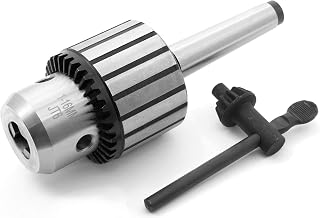
WEN LA164K 5/8-Inch Keyed Drill Chuck with MT2 Arbor Taper
Check PriceThe WEN LA164K is a heavy-duty 5/8-inch keyed drill chuck designed for benchtop drill presses, wood lathes, and stationary machining equipment. Equipped with an MT2 (Morse Taper #2) arbor, it fits directly into matching spindle tapers, providing maximum accuracy, minimal runout, and dependable power transfer under heavy workloads.
Unlike quick-connect adapters for hand tools, this chuck uses a dedicated gear key to tighten its heavy-duty steel jaws. This delivers superior clamping force, making it capable of handling large-diameter drill bit shanks up to 5/8-inch without bit slip—even when driving large Forstner bits, auger bits, or boring tools into tough materials.
- Large Capacity: 5/8-inch (16mm) jaw capacity holds heavy-duty shank bits for shop machines.
- MT2 Shank Fit: Standard Morse Taper #2 mount connects directly to compatible drill presses and lathe tailstocks.
- Best Used For: Precision stationary drilling, wood turning tailstock support, and heavy shop projects.
Keyed vs. Keyless: The Two Main Types of Chucks
Drill chucks primarily come in two varieties, defined by how they are tightened.
Keyed Chucks
A keyed chuck requires a special tool, the drill chuck key, to tighten and loosen its jaws. The key has a gear on its tip that engages with teeth on the body of the chuck. Turning the key provides significant mechanical advantage, allowing the user to apply immense clamping force on the drill bit.
- Pros: Superior gripping power, making them less likely to let a bit slip under heavy load or during the intense vibrations of a hammer drill. They are the standard for drill presses and heavy-duty corded drills.
- Cons: Bit changes are slower, and the chuck key is notoriously easy to lose.
Keyless Chucks
A keyless chuck is tightened and loosened by hand. The user simply grips the chuck’s outer sleeve and twists it to open or close the jaws. Most modern cordless drills feature a keyless chuck for its speed and convenience.
- Pros: Extremely fast and convenient bit changes. No key to lose.
- Cons: Can sometimes loosen during high-torque applications or when the drill’s rotation stops abruptly. They may not grip as tightly as a properly tightened keyed chuck.
Understanding Chuck Size and Capacity
This is one of the most important specifications when buying a drill. The drill chuck size or capacity refers to the maximum diameter of a bit shank that the chuck’s jaws can accept.
The two most common sizes for consumer and professional drills are:
- 3/8-inch (or 10mm): This is the standard size for most general-purpose homeowner drills. It’s perfectly adequate for drilling holes and driving screws in most common tasks. It can accept any bit with a shank diameter of 3/8-inch or less.
- 1/2-inch (or 13mm): This larger size is found on more powerful, heavy-duty, and professional-grade drills. A 1/2-inch chuck is necessary for larger bits used in demanding applications, such as large hole saws, auger bits for wood, or large masonry bits for concrete.
Key Takeaway: A 1/2-inch chuck can hold any bit a 3/8-inch chuck can, but a 3/8-inch chuck cannot hold bits with shanks larger than 3/8-inch. If you anticipate heavy-duty work, a drill with a 1/2-inch chuck is the more versatile choice.
What Do The Numbers Mean? A Guide to Markings and Settings
This is a major point of confusion. There are numbers printed on the chuck itself, and then there is a rotating ring of numbers located behind the chuck. They serve two completely different purposes.
Numbers on the Chuck Itself: Capacity Markings
Any numbers stamped directly onto the metal body of the chuck relate to its technical specifications. You will typically see its capacity range, for example: 1.5 – 13mm” or “1/16 – 1/2”. This simply indicates the minimum and maximum shank diameter the jaws can hold.
Numbers Behind the Chuck: The Torque Clutch
The rotating ring with numbers (e.g., 1, 3, 5… 20) plus a small drill bit icon is the adjustable torque clutch. This is NOT part of the chuck’s gripping mechanism. Its purpose is to control the amount of rotational force (torque) the drill applies when driving a screw.
- Low Number (e.g., 5): This setting provides very little torque. The drill will clutch out (make a clicking sound and stop turning the screw) with minimal resistance. This is perfect for driving small screws into soft materials like drywall or pine, preventing you from stripping the screw head or driving it too deep.
- High Number (e.g., 20): This setting provides maximum torque for driving large screws into hard materials.
- Drill Icon Setting: Turning the collar to this symbol bypasses the clutch entirely. This delivers the motor’s full power and is the setting you must use for drilling holes.
A Deeper Look: What is Drill Chuck Runout?
For precision-focused users, runout is an important concept. In simple terms, runout is a measure of how much a drill bit wobbles off-center as it rotates. In a perfect world, a bit would spin with zero wobble (zero runout). In reality, tiny manufacturing imperfections in both the chuck and the drill’s spindle cause a minuscule amount of wobble. For 99% of tasks like hanging shelves or building a deck, this is completely unnoticeable and irrelevant. However, for high-precision metalworking or fine furniture making, excessive runout can lead to slightly oversized or oval-shaped holes.
Conclusion: Mastering Your Drill’s Most Important Component
The drill chuck is more than just a simple clamp; it’s a precision component that dictates your drill’s capability and versatility. By understanding the difference between keyed and keyless chucks, the importance of 3/8″ vs. 1/2″ capacity, and the function of the torque clutch, you can get the absolute most out of your tool. This knowledge not only makes you a better DIYer but also empowers you to choose the perfect drill for your needs when it’s time for an upgrade.
Disclosure: As an Amazon Associate, we earn from qualifying purchases at no extra cost to you. Our posts are created with AI tools and human editing.